

Definition #
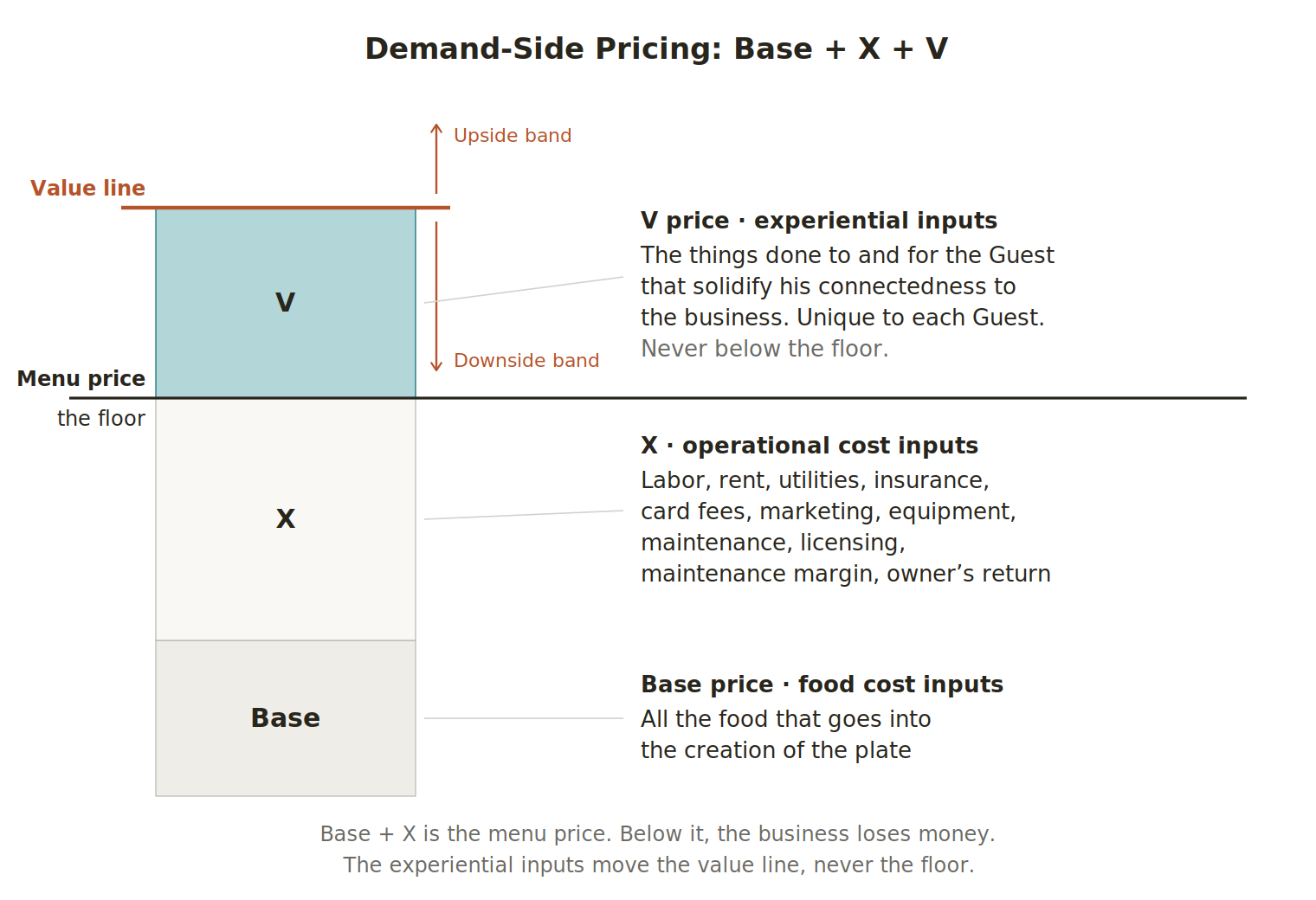
An operator-side pricing discipline where demand — not volume — drives asymmetric variation above the menu price. The menu price is the floor: Base (the food cost inputs, all the food that goes into the creation of a plate) plus [The X Factor]. Below it, the business loses money — the operator is not discounting, they are bleeding. V, the value premium, sits above the menu price. The upside band (high-demand premium) is larger than the downside band (downward pressure on the value line), and the price never goes below the floor. Operator-side, not platform-side: the operator reads demand and sets the bands. Algorithmic-side pricing (Uber surge, airline yield) is the foil.
The price stack runs in three parts. The Base price is the cost price — the food cost inputs, all the food that goes into the creation of a plate. [The X Factor] is the operational cost added to the Base to arrive at the menu price — the operational cost inputs: labor, rent, utilities, insurance, card fees, marketing, equipment, maintenance, licensing, maintenance margin and owner’s return. The V price is the value line — the added value from the experiential inputs, the things the operator does to and for the Guest that solidify his connectedness to the business. They are hard to itemize because they are unique to each Guest. The value line fluctuates based on the perceived value of the GX/CX the Guest or Customer is willing to pay for, and it has to be the result of an operator read on the value market the operator competes in.
Mechanism #
Volume is not demand. Most operators confuse volume with demand. Slow Tuesday, busy Saturday — that reads volume. Real demand can invert both. A Tuesday with a private buyout is high demand at low volume. A rainy Saturday is high volume with depressed demand. [Demand-Side Pricing] reads demand directly.
The floor stays put. The menu price is the price the Guest learns. The floor stays put. Premium moves up on high demand as the value line rises; on low demand the value line comes under downward pressure, V shrinks, and the price holds at the menu price. Both are exception-states, not the new normal. The Guest calibrates to the menu price — the variations read against it.
Dynamic pricing. Dynamic pricing is the process of determining the value line pricing based on several factors — how much V above the menu price the value line supports. It never prices below the floor. When the value line drops below the menu price, the operator re-engineers the plate — the same plate, or a plate built for the occasion. That is a contextual decision made by the operator at the point of business.
Bands are asymmetric on purpose. High demand supports a real premium because the Guest showed up wanting the experience, and price is part of the value signal. Low demand cannot support a price below the floor before three things break: it attracts the wrong Guests, it trains the right Guests to wait for the dip, and it signals weakness. The downside band is a Tuesday instrument. The upside band is a Saturday instrument. They are not symmetric because the Guest’s mental frame is not symmetric — Tuesday drinks from the grocery budget, Saturday drinks from the entertainment budget.
The floor is math. The floor is not a judgment call. It is math. Base plus [The X Factor] is what the plate actually costs to serve, and that is the menu price. Anything below it is loss, not discount. Discounting is not revenue management — it is the absence of it. Cornell’s Enz and Canina found that hotels which drop prices relative to their competitive set capture share but do not gain RevPAR. The restaurant translation: the operator who cuts price to fill seats captures covers but not RevPASH. The operator who holds the menu price and manages demand through the discipline outperforms.
The experiential inputs move the value line, never the floor. Sell a ribeye and mashed potatoes on a paper plate from a food truck, and the Guest is willing to pay one price. Serve the same plate in a restaurant where the cast creates a personalized experience, and the Guest will pay more. The food is the same, so the Base is the same. What moved is the value line, and what moved it is the experiential inputs. The floor is the floor. X is always X — its inputs vary from business to business because no two businesses have the same cost structure — and the experiential inputs do not raise it.
A value market has as many floors as it has operators. Joe’s steak shack is a one-unit business and buys ribeye at his price level. Outback across the street buys ribeye for 2,000 units and gets a much lower price on economies of scale. Steve’s steak shack two streets over is his third unit and buys ribeye cheaper than Joe but still more than Outback. Three floors on the same plate, before anyone adds a single experiential input. No two cost structures are the same, even inside a chain — the same Big Mac priced differently two miles apart. Every operator in the market reads the same Guest’s value line from his own floor.
Economies of scale. Scale lowers the Base. Outback’s savings on 2,000 units give it a choice: add value with the cost savings, or bank them. Steve’s third unit buys him a smaller version of the same choice. Joe, buying at his own price level, does not get the choice at all.
The tension. The tension in the entire process is the balance of costs against the ability to add the experiential inputs that define the value — and the experience that lifts the operator’s value above the floors of his competitors. Joe cannot win at the floor. Outback’s scale buys a lower floor than Joe will ever have. What Joe has is the experience Outback cannot put into 2,000 units the same way: his cast, personalized, at one address. If his V does not lift the value line above his floor and above theirs, he loses on the same plate. This is why operators balk when it is explained to them across the table. Once the [The X Factor] calculations are done, they finally see how much they have to sell each plate for in order to be profitable to the degree necessary. They are exposed to their own cost structure, and they can see it keeping them from competing against chain pricing.
Known value and unknown value. The Guest sees the same ribeye plate at multiple prices and has to prosecute them. The prices are all he can see, and the name can be the most common part — an 8 oz ribeye. The plate is not known unless it has been experienced, and neither is the experience. What he has experienced is known value. What he has not is unknown value until he sits in the room. Outback makes its promise known with a deeper marketing budget than Joe or Steve. But they are all promises until they are experienced. Marketing makes the promise known. Only the experience makes the value known.
Two roots. All of the tensions revolve around one of two things: economies of scale, and the ability of the operator to communicate his value. The floors, the savings, the Tuesday plate that costs more than the Saturday plate, and the X calculations that expose an operator’s cost structure against chain pricing are scale. The known value against the unknown value, and the promise against the experience, are communication.
The same plate is not worth the same every night. How can the same fish plate be worth the same on Tuesday and Saturday? It cannot. What it is worth is set by the Guest’s day in the life, and Tuesday’s Guest and Saturday’s Guest bring different days in the door. A Guest will perceive the higher price as appropriate for a Saturday day in the life but not for a Tuesday day in the life. There are no cuts. When the operator leaves his price static, the value line moves more around it. On Saturday the static price sits under the value line and V goes uncaptured. On Tuesday it can sit over the value line, and the Guest does not see the value at that price.
The Tuesday plate costs more. The same production model works on Tuesday volume as it does on Saturday volume, but economies of scale lower the cost on Saturday and not on Tuesday. The cooler costs the same to run for one case of fish on Tuesday as it does for six on Saturday. So do the rent, the utilities and the minimum labor to open the doors. In illustrative numbers: $1,300 to open the doors for the night, fish at $4.00 a portion. Tuesday runs 100 covers and sells 17 of 20 portions prepped. Saturday runs 300 covers and sells 117 of 120. The Base per plate sold is $4.71 on Tuesday and $4.10 on Saturday. X per cover is $13.00 on Tuesday and $4.33 on Saturday. The same plate costs $17.71 to put on the table Tuesday and $8.43 Saturday. A static price sits closest to cost on the night the Guest’s day in the life puts the value line lowest. The period average hides it — one X per cover blends Tuesday lunch into Saturday dinner. That average sets the floor. Run by daypart, X shows which dayparts carry the most cost per plate.
Tuesday is not Tuesday. Most operators accept that Tuesday is Tuesday and there is nothing they can do about it. The math says otherwise. Tuesday does not cost more because it is Tuesday. It costs more because the volume is low, and every cover the operator adds lowers the cost of every plate in that daypart — fifty more covers takes X per cover from $13.00 to $8.67. The tension is what the operator does to create demand on Tuesday. The answer cannot be the price, because the price never goes below the floor. It has to be the reason to come: a plate built for the occasion, and an experience that answers the Tuesday Guest’s day in the life instead of being a quieter Saturday.
The discount conflation. Operators conflate this argument to justify discounting, saying they will make up the discounted difference with higher volume. That is [Discount Traffic Myth] — the right math, that volume lowers the cost of the plate, used to pull the wrong lever. At a $20 menu price and a $17.71 Tuesday cost, 100 covers earn $229. Cut 20 percent to $16 and every plate sells under its Tuesday cost. It takes about 136 covers, 36 percent more traffic, just to stand still, and the covers a discount brings are the wrong Guests for the wrong reasons. Created demand gets the volume without giving away the price. The discounter buys volume with his margin. The operator who creates demand earns volume and keeps the margin.
Market smarter. Value is not known until it is experienced, so creating Tuesday demand is a communication problem. That is why marketing is critically important, and why the operator has to get it right. He does not have to outspend the chain. He has to market smarter. The chain will most likely engage in mass marketing. The independent has other levers it cannot pull the way he can: the Guests already inside his four walls, personal acts timed to the Guest’s occasions in the gap between visits, the menu as his most-read marketing piece, the positive comp tracked as a marketing expense, and the Guest who becomes his marketing. The positive comp makes value known without touching the price. It is aimed at one Guest on one occasion and it sits on the marketing line, so the menu price and the floor never move. A discount teaches every Guest a lower price. A comp makes one Guest’s experience known.
It starts with the GX/CX. Marketing only amplifies what the operation already produces. If the GX/CX is not engineered to be much better, smarter marketing only makes a bigger promise the room cannot keep. The case runs in order:
- Engineer a much better GX/CX.
- That experience lifts his value line above his floor and above his competitors’ floors.
- Smarter marketing makes that value known.
- Known value creates demand, including on Tuesday.
- Volume lowers the cost of every plate.
- [Demand-Side Pricing] captures V where the value line supports it and holds the floor where it does not.
- V funds the growth.
A job or a business. X means the operator bought himself a job. V means he has a growing, thriving business. X holds the designed operation and pays the owner. It does not fund growth. V does. That is why [Demand-Side Pricing] is critical to an operator’s success and not just a better way to price. The operator on a static price, or the one who discounts, can survive at his floor and never grow. Contribution-margin thinking — any plate above food cost helps cover the fixed costs — only means he is paying himself less to keep the job he bought.
The read comes first. [Demand-Side Pricing] without a [Competitive Value Read] is guessing. The operator has to know where the menu price sits in the market segment — parity, above, or below — before the bands mean anything. That is a read failure before it is a pricing failure.
The discipline is the platform. Not software — a repeatable read run before the shift, not after the damage. POS reads the demand signal after it arrives. The reservation system reads it before. Labor and scheduling reads the cost side of the yield equation. Three systems the operator needs talking to each other. When they talk, the operator has a demand-side pricing engine that no platform can replicate — because it is built on his specific operation’s data, his specific Guest relationship, his specific market. Lighthouse serves ten thousand hotels with the same algorithm. His discipline serves one operation with the full context. AI amplifies the discipline once it exists. AI without the discipline underneath produces algorithmic noise, not decisions.
Load-Bearing Distinction #
Not discounting. Discounting moves the price below the menu price to buy volume, and below the menu price the business loses money. [Demand-Side Pricing] never goes below the floor. The downside band is downward pressure on the value line, and the price holds at the menu price.
Not surge pricing. Uber surge and airline yield move the price from the platform’s side, by the same algorithm across every seller. [Demand-Side Pricing] moves the price from the operator’s side, for one operation, against his own read of the value market he competes in.
Not [Transactional Cost-Plus]. Cost-plus derives the price from the operator’s own ledger. The ledger sets the floor — Base plus [The X Factor]. It never sets the value line. The value line is set by the perceived value of the GX/CX the Guest is willing to pay for.
Not service. Service is executed, and its inputs are operational cost inputs. They sit in [The X Factor], under the floor. The experiential inputs are the things done to and for the Guest that solidify his connectedness to the business, and they sit in V, above it.
Not [The X Factor]. [The X Factor] is the operational cost added to the Base to arrive at the menu price. It lives under the floor. [Demand-Side Pricing] works above it, at the value line.
Not volume management. Moving the price with the cover count gets the private-buyout Tuesday wrong and the rainy Saturday wrong. [Demand-Side Pricing] reads demand directly.
The term is load-bearing because the industry gives operators two moves on price: hold one price everywhere, or cut it when it is slow. Both ignore the value line, and the second one goes below the floor. Without the term named, the slow night always reads as a price problem. With it named, the slow night reads as downward pressure on the value line and a plate that needs work.
Diagnostic Tests #
Test One — The Floor Test. Ask whether any item has ever sold below its menu price on any occasion — a weeknight special, a happy hour price, a slow-night promotion. If it has, the business sold that item at a loss, and the floor is not holding.
Test Two — The Stack Test. Ask the operator for the Base price and X on his top five items. If he cannot produce both, he does not know his floor, and he cannot know what he is charging above it.
Test Three — The Saturday Test. Look at the busiest occasions of the last period. Ask what the operator did when demand peaked: held the price, throttled a channel, or priced up to the value line. Holding or throttling means the upside band has never been used.
Test Four — The Tuesday Test. Look at the slowest occasions. Ask what the operator did: cut the price, or worked the plate. A cut means the downside band is being run as a discount. Nothing means the value line is not being read.
Test Five — The Competitor Floor Test. Ask the operator who else sells his signature plate in his value market, and what they charge for it. If he does not know, he cannot know whether his experience lifts his value above their floors.
Test Six — The Experiential Inputs Test. Ask the operator to name what a Guest gets in his room that the cheapest version of the same plate in his market does not deliver. If he cannot name the experience, he has nothing to lift the value line with.
Test Seven — The Platform Test. Ask who sets the price on each channel. If a platform or a vendor’s algorithm sets it, the read underneath the price is not his.
Family Position #
Sits inside Profit, in the pricing family, as the discipline that works the price stack above the floor. Built on [The X Factor], which with the Base sets the menu price. Requires [Competitive Value Read] to read the value market the operator competes in. Stands against [Transactional Cost-Plus] and against discounting. Cross-Fundamental: the value line it reads is produced by every Fundamental.
Perspective read. The industry teaches operators to price up from their costs and to cut when the room is slow. The operator running that read balks when the [The X Factor] calculations finally show him what each plate has to sell for to be profitable to the degree necessary, and he sees his own cost structure keeping him from competing against chain pricing. He detects it in himself when he can quote his food cost and cannot say what his Saturday Guest would pay. The response is to read the value line on every occasion: hold the menu price as the floor, follow the line up when it rises, and treat the line falling below the floor as a plate question.
Product read. The plate is not known value until the Guest has experienced it. When the value line drops below the menu price, the Guest is saying the offer at that price is not worth it on this occasion. The operator re-engineers the plate — the same plate, or a plate built for the occasion — and the floor holds. The skipped read shows up as the Tuesday special that is the Saturday plate at a lower price, which tells the Guest the Saturday price was never the real one.
People read. The cast’s labor is an operational cost input and sits in X. What the cast does to and for each Guest that solidifies his connectedness to the business is the experiential input, and it is what separates the ribeye in the room from the ribeye on the paper plate. A cast that personalizes the experience is what lifts Joe’s value line above Outback’s floor. A cast scheduled to volume instead of demand runs short on the nights the upside band is paying for, and a cast that watches the operator cut on a slow night learns the operation’s value is negotiable and carries that to the Guest.
Performance read. Dynamic pricing prices to the value line the operator read before the shift. Execution decides whether the Guest experiences that line. A premium on a busy night assumes the stage holds; the first missed ticket drops the value line under the price, and the Guest leaves having paid for something he did not get. The operator detects it when comps and complaints cluster on his highest-priced occasions. The response is to price no closer to the value line than his execution on that occasion can hold.
Profit read. The floor is Base plus [The X Factor], and below it the business loses money. The V price is what the Guest pays above it, set at the value line. The operator who discounts sells under his floor. The operator who never prices the upside leaves V on the table every busy night. And the operator with the highest floor in his value market — Joe, not Outback — has the least room under any given value line, which is why his money has to go into the experiential inputs that lift it.
Cross-References To Locked IP #
Parent:
- [Five Fundamentals] — the structure the value line is produced across
Related:
- [The X Factor] — the operational cost added to the Base to arrive at the menu price; load-bearing — the floor cannot be understood without it
- [Competitive Value Read] — the operator read on the value market that the value line has to come from
- [Value Market] — the market of Guests and competing value propositions every floor in it is read against
- [Meaningfully Differentiated Value] — what the experiential inputs have to produce to lift the value line above competitors’ floors
- [Lost Opportunity Tax] — the RevPASH the discount left on the table
- [Amplification Principle] — build the discipline first, then amplify with technology
Opposing patterns:
- [Transactional Cost-Plus] — derives the price from the ledger instead of the value line
- [Transactional Lie #1 — Affordability Lie] — the belief that competing means discounting
- [Discount Reflex] — the habit of cutting the price on a slow night
- [Discount Traffic Myth] — the belief that a price below the floor fills the room
- [Discount Confession] — what a price below the floor tells the Guest, the cast and the market
Why This Matters #
Why does the same plate cost the same on a slow Tuesday and a sold-out Saturday? Most operators answer that it is just how it works. That is a habit, not an answer, and it costs the operation on both nights. The same plate is not worth the same on Tuesday and Saturday, and it does not cost the same either. On Saturday a static price leaves the premium the Guest was ready to pay on the table. On Tuesday it sits closest to cost on the night the Guest values the plate least, and when the room stays empty the habit turns into a cut below the floor.
I named it because the industry only ever gave operators those two moves, and both ignore the one thing that decides whether the Guest buys: the value line, set by the perceived value of the GX/CX he is willing to pay for. The platforms figured out how to price to the occasion a long time ago, and they did it for themselves. Dynamic pricing pointed at the value line, run by the operator for his own operation, is what was missing.
It matters most for the operator with the highest floor in his market. Joe will never buy ribeye at Outback’s price. He can still win, because the Guest pays at the value line, not at the floor, and the experiential inputs are the only thing that move it. Every operator is standing on his own floor. The discipline is how he reads where the value line sits above it, and how he lifts it.
And it decides what the operator owns. X means the operator bought himself a job. V means he has a growing, thriving business. Without [Demand-Side Pricing], he survives at his floor and never captures the V that funds the growth.
Operating Consequence #
Hold the floor without exception. The menu price is the floor. No special, promotion, or slow-night price goes under it.
Know the stack. The operator knows the Base price and X for every item, and knows what he charges above the menu price is V.
Read the value market before the shift. Demand, the Guest’s budget frame for the occasion, and where the operation sits against the floors of its competitors are read before the price is set.
Run X by daypart. The period calculation sets the floor. Run X per cover by daypart as well, to see which dayparts carry the most cost per plate.
Create the demand, never buy it. On the dayparts that carry the most cost, the operator creates demand with the experience and smarter marketing, never with a price below the floor.
Follow the value line up. On the occasions where the line rises, the price follows it, up to the line and no further.
Answer the downside with the plate. When the value line drops below the menu price, the operator re-engineers the plate — the same plate or one built for the occasion — and the floor holds.
Engineer the GX/CX before marketing it. Marketing amplifies what the operation already produces. A much better GX/CX comes first.
Put the money into the experiential inputs. The operator stops treating the experience as one more cost on a floor he is already fighting, and treats it as the only thing that lifts his value above his competitors’ floors.
Keep the read on the operator’s side. No platform or vendor algorithm sets the price on any channel without the operator’s read underneath it.
What Changes Tomorrow #
Take your top five items and write the Base price and X next to each one. That sum is your menu price and your floor. Then find out what the two closest competitors in your value market charge for the same plates. Write those next to yours.
Pull the last full period of sales by occasion. Mark the five busiest and the five slowest. For the busiest, write down what you did when demand peaked: held the price, shut a channel, or priced up. For the slowest, write down what you did: cut the price, ran a special, or nothing. Anything that sold below the menu price on those slow occasions sold at a loss, and that is where the work starts.
Run X per cover by daypart for the same period: the operating costs of each daypart divided by its covers. Mark the daypart with the highest X per cover. That is where created demand pays back the most.
For one busy occasion next period, read the value line before the shift and price the upside band to it. For one slow occasion, leave the price where it is and work the plate instead. Read both against the occasions you marked.
The floor does not move. The value line does. The operator’s job is to read it, follow it up, and lift it above the floors around him with the experience only his operation delivers.


